2025-04-14
Data Structure & Algorithm Template
TrieTree(前缀树)
Trie (发音类似 "try")或者说 前缀树 是一种树形数据结构,用于高效地存储和检索字符串数据集中的键。这一数据结构有相当多的应用情景,例如自动补全和拼写检查。
package DSA;
class TrieNode{ private char c; private boolean isEnd; private TrieNode[] children; private static final int ALPHABET_SIZE = 26; public TrieNode(){ this.children = new TrieNode[ALPHABET_SIZE]; this.isEnd = false; } public TrieNode(char c){ this(); this.c = c; } public boolean isStartWith(char c){ return this.c == c; } public boolean isEnd(){ return this.isEnd; } public TrieNode[] getChildren(){ return this.children; } public void setEnd(boolean isEnd){ this.isEnd = isEnd; } } public class TrieTree { TrieNode root; public TrieTree(){ this.root = new TrieNode(); } public void insert(String word){ TrieNode cur = root; for(char c:word.toCharArray()){ int index = c - 'a'; if(cur.getChildren()[index] == null){ cur.getChildren()[index] = new TrieNode(c); } cur = cur.getChildren()[index]; } cur.setEnd(true); } public boolean search(String word){ TrieNode cur = root; for(char c:word.toCharArray()){ int index = c - 'a'; if(cur.getChildren()[index] == null){ System.out.println("Not Found"); return false; } cur = cur.getChildren()[index]; } return cur.isEnd(); } public boolean startsWith(String prefix){ TrieNode cur = root; for(char c:prefix.toCharArray()){ int index = c - 'a'; if(cur.getChildren()[index] == null){ System.out.println("Not Found"); return false; } cur = cur.getChildren()[index]; } return true; } public static void main(String[] args){ TrieTree trie = new TrieTree(); trie.insert("apple"); System.out.println(trie.search("apple")); // returns true System.out.println(trie.search("app")); // returns false System.out.println(trie.startsWith("app")); // returns true trie.insert("app"); System.out.println(trie.search("app")); // returns true } }
LRU cache
LRU是Least Recently Used的缩写,即最近最少使用,是一种常用的页面置换算法,选择最近最久未使用的页面予以淘汰。该算法赋予每个页面一个访问字段,用来记录一个页面自上次被访问以来所经历的时间 t,当须淘汰一个页面时,选择现有页面中其 t 值最大的,即最近最少使用的页面予以淘汰。对应的,这里的cache就是采用lru策略的一个缓存系统。
package DSA;
import java.util.HashMap;
import java.util.Map;
class ListNode
void moveToHead(ListNode<T> node){
    if(head.next == node){
        return;
    }
    node.before = head;
    node.next = head.next;
    head.next.before = node;
    head.next = node;
}
void removeNode(ListNode<T> node){
    node.before.next = node.next;
    node.next.before = node.before;
}
public int size(){
    return map.size();
}
public void print(){
    ListNode<T> cur = head.next;
    while(cur != tail){
        System.out.print(cur.key + " ");
        cur = cur.next;
    }
    System.out.println();
}
public static void main(String[] args) {
    LRUcache<String> cache = new LRUcache<>(3);
    cache.put(1, "haha1");
    cache.put(2, "haha2");
    cache.put(3, "haha3");
    cache.print(); // 1 2 3
    System.out.println(cache.get(3)); // haha3
    cache.put(4, "haha4");
    cache.print(); // 2 3 4
    System.out.println(cache.get(1)); // null
}
}
最短路径Algorithm
Floyd算法
是用来求任意两个结点之间的最短路的。
复杂度比较高,但是常数小,容易实现(只有三个 for)。
适用于任何图,不管有向无向,边权正负,但是最短路必须存在。(不能有个负环)
我们定义一个数组 f[k][x][y],表示只允许经过结点 到
(也就是说,在子图
中的路径,注意,
与
不一定在这个子图中),结点
到结点
的最短路长度。
很显然,f[n][x][y] 就是结点 到结点
的最短路长度(因为
即为
本身,其表示的最短路径就是所求路径)。
for (k = 1; k <= n; k++) {
for (x = 1; x <= n; x++) { for (y = 1; y <= n; y++) { f[x][y] = min(f[x][y], f[x][k] + f[k][y]); } } }
by the way……
最小环(using floyd)

int val[MAXN + 1][MAXN + 1]; // 原图的邻接矩阵
int floyd(const int &n) { static int dis[MAXN + 1][MAXN + 1]; // 最短路矩阵 for (int i = 1; i <= n; ++i) for (int j = 1; j <= n; ++j) dis[i][j] = val[i][j]; // 初始化最短路矩阵 int ans = inf; for (int k = 1; k <= n; ++k) { for (int i = 1; i < k; ++i) for (int j = 1; j < i; ++j) ans = std::min(ans, dis[i][j] + val[i][k] + val[k][j]); // 更新答案 for (int i = 1; i <= n; ++i) for (int j = 1; j <= n; ++j) dis[i][j] = std::min( dis[i][j], dis[i][k] + dis[k][j]); // 正常的 floyd 更新最短路矩阵 } return ans; }
Bellman–Ford 算法
Bellman–Ford 算法是一种基于松弛(relax)操作的最短路算法,可以求出有负权的图的最短路,并可以对最短路不存在的情况进行判断。
在国内 OI 界,你可能听说过的「SPFA」,就是 Bellman–Ford 算法的一种实现。
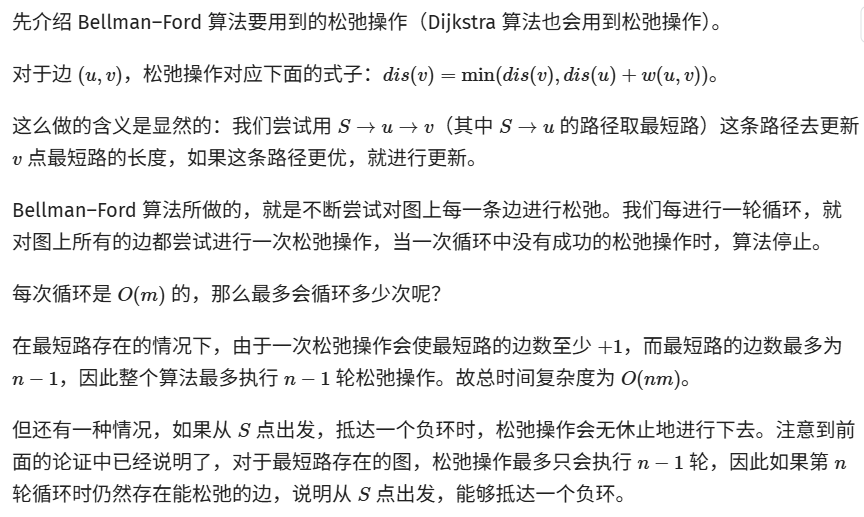
class Edge:
def __init__(self, u=0, v=0, w=0):
    self.u = u
    self.v = v
    self.w = w
INF = 0x3F3F3F3F edge = []
def bellmanford(n, s): dis = [INF] * (n + 1) dis[s] = 0 for i in range(1, n + 1): flag = False for e in edge: u, v, w = e.u, e.v, e.w if dis[u] == INF: continue # 无穷大与常数加减仍然为无穷大 # 因此最短路长度为 INF 的点引出的边不可能发生松弛操作 if dis[v] > dis[u] + w: dis[v] = dis[u] + w flag = True # 没有可以松弛的边时就停止算法 if not flag: break # 第 n 轮循环仍然可以松弛时说明 s 点可以抵达一个负环 return flag
很多时候我们并不需要那么多无用的松弛操作。
很显然,只有上一次被松弛的结点,所连接的边,才有可能引起下一次的松弛操作。
那么我们用队列来维护「哪些结点可能会引起松弛操作」,就能只访问必要的边了。
struct edge {
int v, w;
};
vector
Dijkstra 算法
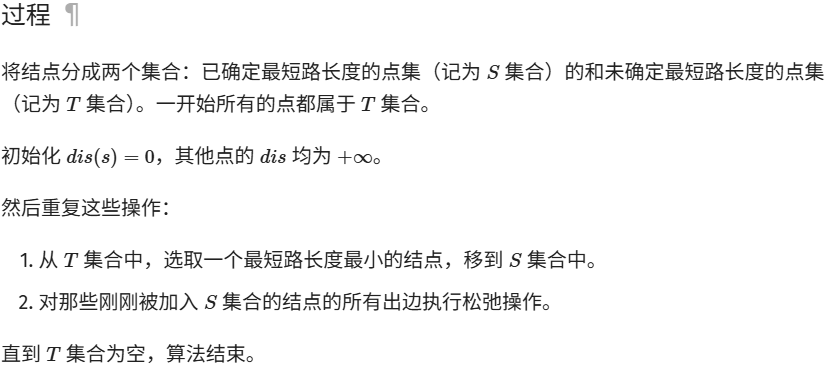
两种实现:
struct edge {
int v, w;
};
vector
struct edge {
int v, w;
};
struct node {
int dis, u;
bool operator>(const node& a) const { return dis > a.dis; }
};
vector
java版本:
import java.util.Scanner;
import java.util.*;
// 注意类名必须为 Main, 不要有任何 package xxx 信息
public class Main {
// 定义一个静态内部类,用于表示图中的边
static class Edge {
int to; // 边的目标节点
int weight; // 边的权重
public Edge(int to, int weight) {
this.to = to;
this.weight = weight;
}
}
// Dijkstra 算法主函数
public static int[] dijkstra(List<List
public static void main(String[] args) {
    Scanner in = new Scanner(System.in);
    int n = in.nextInt(), m = in.nextInt(), q = in.nextInt();
    List<List<Edge>> graph = new ArrayList<>();
    int u, v, w;
    for (int i = 0; i <= n; i++){
        graph.add(new ArrayList<>());
    }
    for (int i = 0; i < m; i++) {
        u = in.nextInt();
        v = in.nextInt();
        w = in.nextInt();
        graph.get(u).add(new Edge(v,w));
    }
    int[] dist =dijkstra(graph,1);
    int[] ans = new int[q];
    int ret=0;
    for(int i=0;i<q;i++){
        ret+=2*dist[in.nextInt()];
    }
    System.out.println(ret);
}
}